
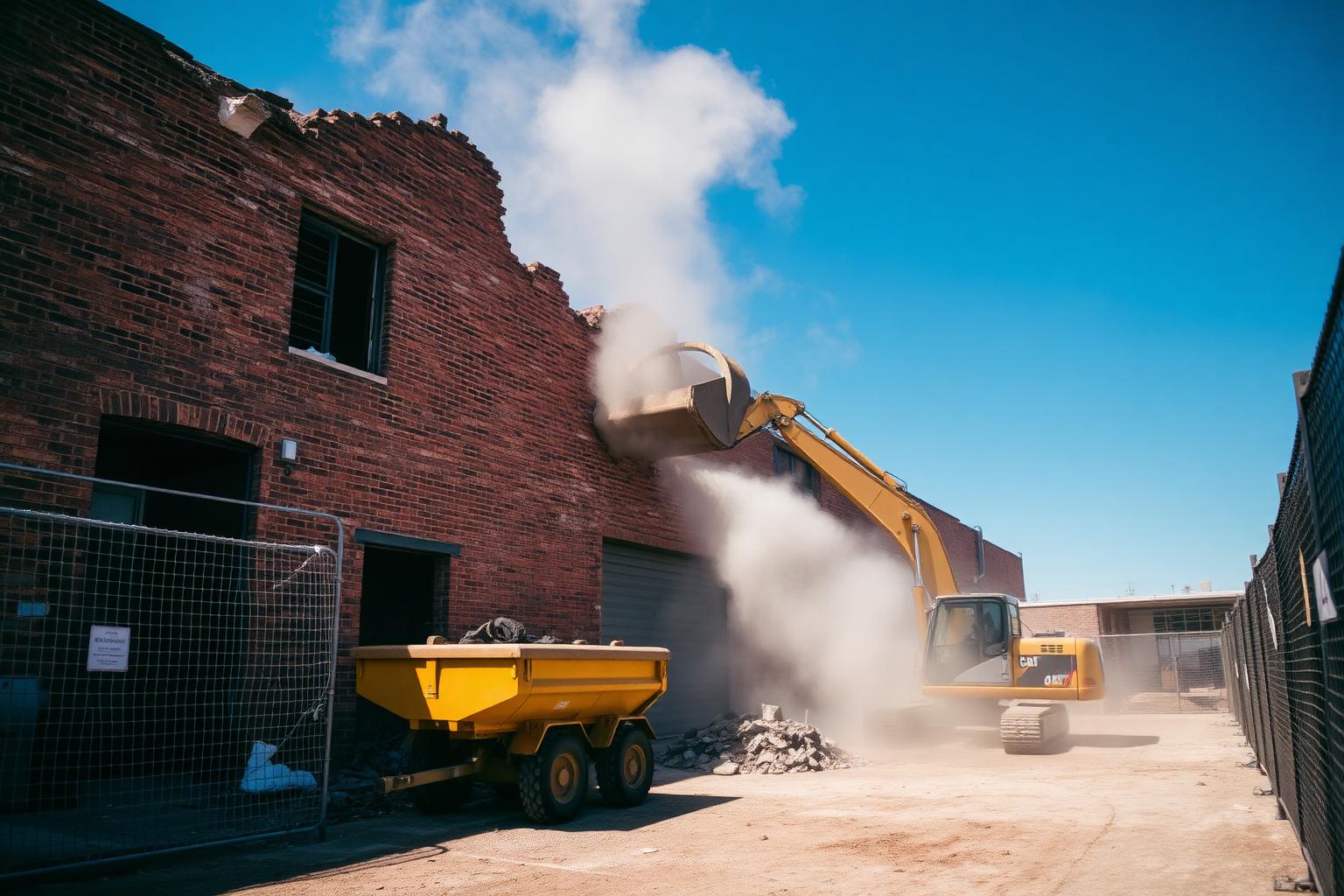
ISO Certification for Demolition
Win head-contractor onboarding, prove your high-risk safety system, and clear environmental sign-off.
Demolition is one of the most scrutinised trades in Australian construction. Between SafeWork licensing, asbestos notifications, EPA waste tracking and head-contractor prequal portals, the paperwork on a single job can outweigh the actual strip-out.
We connect demolition contractors with JAS-ANZ-accredited certification bodies for ISO 45001 (Safety), ISO 9001 (Quality) and ISO 14001 (Environment), and help you build a management system that actually matches how your crews work — not 200 pages of unread procedures.
Whether you're a Class 3 outfit running soft-strip and minor structural, or a Class 1 contractor pricing high-rise structural demolition with friable asbestos, the certification mechanics are the same — the audit emphasis isn't. Local operators like Wiradjuri Demolitions in the Hunter are good examples of demolition businesses where ISO sits naturally alongside SafeWork licensing and EPA controls. If your work crosses into excavation and civil packages, our civil & infrastructure page covers the downstream prequal triggers in more detail.
Why it matters
Why demolition contractors get ISO certified
Demolition appears disproportionately in SafeWork Australia's serious-incident data — falls from height, struck-by, structural collapse, asbestos exposure and silica dust are all over-represented. Every state regulator treats demolition as high-risk construction work, and most Tier 1 builders now require ISO 45001 (or evidence of an equivalent third-party-verified system) before issuing a purchase order above a project value threshold.
The demolition contractors we work with usually arrive with one of four pressures: a Tier 1 onboarding portal, a council or government tender, an insurer demand after a near-miss, or an EPA waste-tracking review. The free gap analysis is the fastest way to see which gaps will actually fail you at audit.
Tier 1 builder & principal onboarding
Lendlease, Multiplex, John Holland, CPB and Built routinely require ISO 45001 for demolition subcontractors — particularly on jobs involving asbestos, structural demolition or work near live operations.
SafeWork licensing alignment
Friable and non-friable asbestos removal licences, high-risk work licences and demolition class licences sit naturally on top of an ISO 45001 system — auditors expect to see your licences referenced inside your safety management system.
EPA waste tracking & environmental sign-off
State EPAs require waste classification, transport tracking and disposal evidence for demolition materials, asbestos, contaminated soil and recyclables. ISO 14001 gives auditors and councils the documented chain of custody they expect.
Avetta, Cm3 & ISNetworld prequal
Demolition modules in prequal portals are some of the strictest. Holding ISO 45001 / 14001 reduces the volume of policy uploads and shortens re-approval at renewal.
Which standard matters most
The right ISO standards for demolition contractors
ISO 45001
The non-negotiable. Covers SWMS for high-risk construction work, asbestos and silica controls, exclusion zones, plant operator licensing, working at height, lift studies and structural awareness — the things auditors and Tier 1 safety teams ask about first.
ISO 9001
Quality and process control. Demonstrates you actually deliver to the agreed scope — methodology, sequencing, hold points, hand-back condition, salvage and recycling records.
ISO 14001
Environmental management. Asbestos removal, contaminated soil, dust and noise, water and hydrocarbon control, recyclable streams, and EPA waste tracking. Increasingly required on council, government and major-builder demolition packages.
Sub-sectors we support
Specialists across the demolition supply chain
Structural demolition
Class 1/2 high-risk including high-rise and load-bearing structures.
Soft-strip & internal demolition
Fit-out strip-out, commercial and retail refurbishment.
Asbestos removal
Friable (Class A) and non-friable (Class B) licensed removalists.
Hazardous materials & contamination
Lead paint, PCBs, SMF, contaminated soils.
Concrete cutting & sawing
Wall sawing, core drilling, controlled demolition.
Industrial dismantling
Plant decommissioning, tank removal, process facility strip-outs.
Civil & infrastructure demolition
Bridges, culverts, road structures — see also civil & infrastructure.
Residential demolition
Detached and multi-residential knock-downs.
Salvage & deconstruction
Material recovery and selective dismantling for reuse.
Tender & prequal triggers
Where demolition contractors are being asked for ISO right now
The schemes and clients putting ISO certification on the table for Australian demolition contractors.
Avetta
Demolition is flagged as high-risk; ISO 45001 satisfies multiple safety modules and shortens questionnaire load.
Cm3
Demolition contractors are scrutinised more heavily than most trades — ISO certification accelerates the path to 'Prequalified'.
ISNetworld
Used by resources and infrastructure principals; ISO 45001 + 14001 lifts the grade score significantly for demolition scopes.
Tier 1 head contractors
Lendlease, Multiplex, John Holland, CPB, Built and Hindmarsh routinely request 45001 for demolition subcontractor onboarding.
Council & government panels
Transport authorities, Defence Estate Works, and metropolitan councils score ISO in weighted criteria — particularly for asbestos and contaminated-site works.
How the process works
From gap analysis to certificate
Free gap analysis
we benchmark your current SWMS, licences and EPA tracking against ISO 45001 / 14001 / 9001 in plain English.
Build or align the management system
high-risk work procedures, asbestos and hazmat workflows, plant and operator licensing, waste tracking, contractor management.
Internal audit & management review
close the gaps before an external auditor sees them.
Stage 1 audit (documentation) with a JAS-ANZ-accredited certification body.
Stage 1 audit (documentation) with a JAS-ANZ-accredited certification body.
Stage 2 audit (site & implementation)
auditor verifies the system is actually used on a live demolition site.
Certificate issued
typically valid 3 years with annual surveillance audits.
Cost & timeline reality check
Demolition certification cost depends on standards in scope, headcount, number of physical depots and the licence classes held — not the value of any single demolition contract. Most demolition businesses move through the full path in 3–6 months once the gap analysis is done. See our ISO certification cost guide and certification timeline for the current bands.
Who delivers this
Independent partners behind your demolition certification
ISO Certification Group connects demolition contractors with two specialist partners — one builds the system, the other audits it. They operate independently of each other, which is what keeps your certificate credible.
System Development Consultants
Industry-aware consultants who build the management system around how demolition contractorsactually run — gap analysis, documentation, internal audit, and audit-day support.

Nathan Owen
Founder & Consultant

Tanya Protasova
Consultant

Jodie Rice
Consultant

Independent Certification Auditors
JAS-ANZ accredited auditors who issue your certificate of registration. Independent of the consulting team, which is what keeps your certificate credible with procurement and regulators.

Ethan Fricke
Founder & Lead Auditor

Scott Boundy
Lead Auditor

Sam West
Lead Auditor
Alternative pathway
Not ready for full certification?
If a head-contractor onboarding portal is due in two weeks and you're three months away from being audit-ready, Spire Safety can deliver a documented, third-party-supported safety management system that satisfies most prequal modules at a fraction of the cost — and gives you a clean runway into full ISO certification when you're ready.
It's the option we recommend when the tender clock and the audit clock don't line up.
FAQs
ISO certification for demolition contractors — your questions
Can't find what you're looking for? Our team is ready to help with any questions about ISO certification.
Contact Our TeamAbout the Author
Nathan Owen
Nathan has worked in HSEQ management for 15 years helping Australian businesses improve compliance, manage risk and gain ISO Certification. He has masters degrees in business management and WHS.
More industries
ISO certification for other Australian industries
Ready to clear prequal and win the next tender?
Talk to us about ISO 45001, 9001 and 14001 certification for demolition contractors — or run the free gap analysis to see where you stand today.